


Table of Contents
- The Ultimate Guide to Fiber Optic Cable Types: Choosing the Right One for Your Network
- Singlemode vs. Multimode: The Big Divide
- OS1 and OS2: The Singlemode Workhorses
- OM1 and OM2: The Legacy Multimode Players
- OM3 and OM4: The Data Center Favorites
- OM5: The Multimode Future
- Choosing the Right Fiber: Use Case Scenarios
- Final Thoughts
The Ultimate Guide to Fiber Optic Cable Types: Choosing the Right One for Your Network
Fiber optics are the unsung heroes of modern connectivity. Whether you’re streaming a movie, backing up data to the cloud, or running a high-frequency trading algorithm, chances are fiber is doing the heavy lifting behind the scenes. But not all fiber optic cables are created equal. If you’ve ever wondered what the difference is between OS1 and OM4—or why OM5 is green—this guide is for you.
Let’s break down the major types of fiber optic cables, compare their strengths, and explore where each one shines.
Singlemode vs. Multimode: The Big Divide
Before diving into specific types, it’s important to understand the fundamental split in fiber optics: singlemode and multimode.
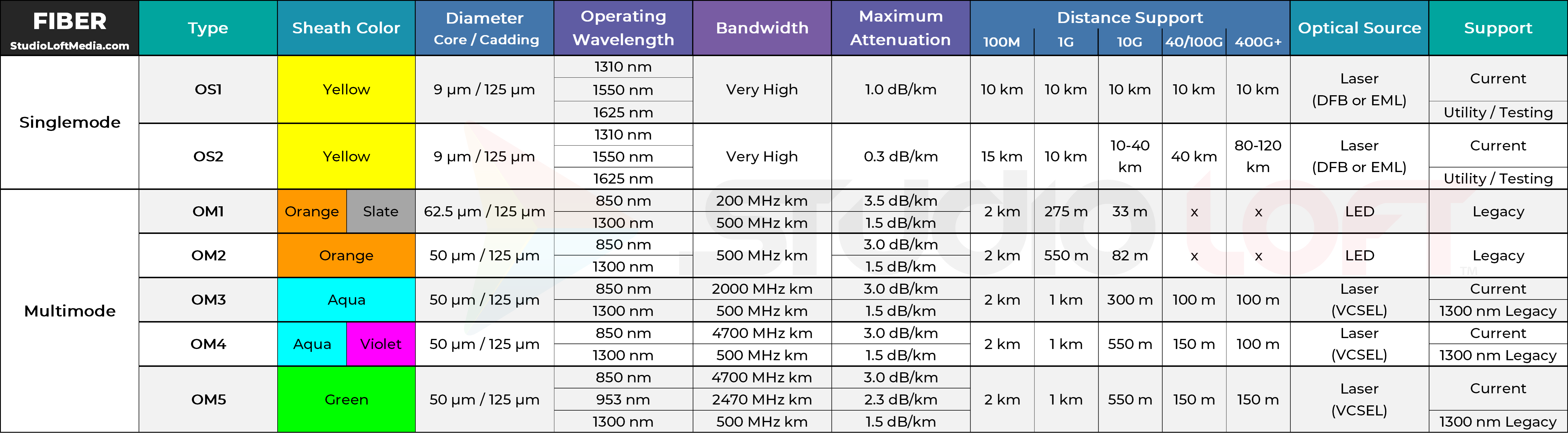
Singlemode fiber has a very narrow core (about 9 microns) and allows only one mode of light to travel through it. This minimizes signal dispersion and enables transmission over very long distances—think tens of kilometers. It’s the go-to choice for telecom providers, long-haul data links, and backbone infrastructure.
Multimode fiber, on the other hand, has a wider core (50 or 62.5 microns) and supports multiple light paths. This makes it ideal for short-range, high-bandwidth applications like data centers and enterprise LANs. It’s cheaper to deploy but has distance limitations due to modal dispersion.
⸻
OS1 and OS2: The Singlemode Workhorses
OS1 is designed for indoor use, typically within buildings. It’s optimized for shorter distances (up to 10 km at 10 Gbps) and has slightly higher attenuation than its outdoor counterpart. You’ll find OS1 in riser shafts, telecom closets, and building backbones.
OS2 is the evolution of OS1, built for outdoor and long-haul applications. It features lower attenuation (as low as 0.3 dB/km) and can support distances up to 40 km at 10 Gbps—and even more with advanced optics. OS2 is the preferred choice for metro networks, campus-wide deployments, and inter-building links.
🟡 Both OS1 and OS2 use yellow sheathing and support wavelengths like 1310 nm, 1550 nm, and 1625 nm. They rely on laser sources such as DFB (Distributed Feedback) and EML (Electro-absorption Modulated Lasers).
⸻
OM1 and OM2: The Legacy Multimode Players
OM1 is the oldest multimode standard still in use. It has a 62.5-micron core and supports LED light sources. Its bandwidth is limited (200–500 MHz·km), and it can only handle 10 Gbps over about 33 meters. You’ll find OM1 in older LAN setups and legacy systems that haven’t been upgraded.
OM2 improves on OM1 with a 50-micron core and slightly better bandwidth (500 MHz·km). It can stretch 10 Gbps up to 82 meters. While OM2 is more capable than OM1, it’s still considered outdated for modern high-speed networks.
🟠 Both OM1 and OM2 typically use orange sheathing and are rarely deployed in new installations. They’re mostly retained for backward compatibility.
⸻
OM3 and OM4: The Data Center Favorites
OM3 was a game-changer when it arrived. With a 50-micron core and support for VCSEL (Vertical-Cavity Surface-Emitting Laser) sources, OM3 can handle 10 Gbps up to 300 meters and even 40/100 Gbps with parallel optics. It’s ideal for data centers, storage area networks (SANs), and high-speed enterprise LANs.
OM4 builds on OM3 with even greater bandwidth (4700 MHz·km) and extends 10 Gbps reach to 550 meters. It’s the go-to for high-performance environments where speed and reliability are paramount.
🔵 OM3 and OM4 typically use aqua-colored sheathing, though OM4 may also appear in violet. They’re widely deployed in modern infrastructure and offer excellent cost-to-performance ratios.
The distinctive “Erika Violet” color used for OM3 and OM4 multimode fiber jackets isn’t just a random shade of purple — it has a botanical origin. The name comes from the Erica genus, a type of flowering heather plant known for its soft violet-purple blossoms. When the IEC and ISO standards bodies standardized cable jacket colors to help distinguish fiber types, this particular hue was chosen for high-bandwidth multimode fibers because it was visually distinct from orange (OM1/OM2) and aqua (used later for OM5). The “Erika Violet” name stuck as both a technical identifier and a subtle nod to nature, pairing high-speed optical performance with a memorable, elegant color reference.
⸻
OM5: The Multimode Future
OM5 is the newest multimode standard, designed to support Shortwave Wavelength Division Multiplexing (SWDM). This allows multiple wavelengths (850 nm, 953 nm, etc.) to travel simultaneously over a single fiber, increasing capacity without adding more cables.
OM5 maintains the same core size as OM3/OM4 (50 microns) and supports 10 Gbps up to 550 meters. It’s ideal for hyperscale data centers, cloud providers, and environments where future scalability is key.
🟢 OM5 uses green sheathing and is backward-compatible with OM3 and OM4. While adoption is still growing, it’s positioned as the next step in multimode evolution.
⸻
Choosing the Right Fiber: Use Case Scenarios
Here’s a quick rundown of which fiber type fits which scenario:
• Campus or metro networks: OS2 is your best bet for long-distance, outdoor links. • Building backbone: OS1 works well for indoor runs between telecom rooms. • Legacy LANs: OM1 or OM2 may still be in use, but consider upgrading. • Enterprise data centers: OM3 and OM4 offer excellent performance for 10G/40G/100G. • Hyperscale environments: OM5 supports SWDM and future-proofing.
⸻
Final Thoughts
Fiber optics may seem complex at first glance, but once you understand the core differences—literally and figuratively—it becomes much easier to choose the right type for your needs. Whether you’re wiring a small office or designing a sprawling data center, matching the fiber type to your performance, distance, and budget requirements is key.
And remember: while multimode is great for short-range, high-speed applications, singlemode is unmatched for long-haul and future scalability. The right choice today can save you from costly upgrades tomorrow.

Start the conversation